Santa Cruz District
La piel del tamborSanta Cruz District is Seville’s historic former Jewish quarter, rebuilt in the early twentieth century and situated close to Seville Cathedral and the Archbishop’s Palace. In the novel, its narrow streets and accumulated histories surround the Church of Our Lady of Tears, whose ruinous state and valuable site draw church officials, a banking family, developers, and Lorenzo Quart into conflict. The district’s past is not simply scenery: it gives material form to the contest between inherited memory and the forces seeking to secularize and redevelop the present.
Definition and Historical Setting
Quart recognizes Santa Cruz as the old Jewish quarter, reconstructed at the beginning of the twentieth century. Its proximity to the cathedral and the Archbishop’s Palace places the neighborhood beside the principal institutions of Seville’s Catholic authority, while its own streets preserve evidence of a history older and more layered than any single institution. The novel presents the city as a superimposition of histories and ties, a place where different religions and languages have left traces in enduring stone.
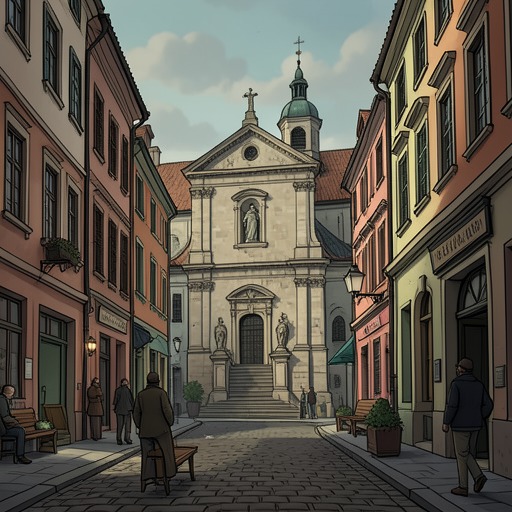
That layered past becomes especially legible in Santa Cruz’s streetscape. Quart’s tourist map proves useless in a maze of silent, narrow lanes, with whitewashed and ochre façades, shadowed doorways, and patios glimpsed behind gates. He reaches a small square with tiled benches depicting scenes from Don Quixote, iron grilles hung with flowerpots, and orange trees. The setting’s beauty is inseparable from its intimacy: the church is tucked into a compact urban fabric rather than standing apart from it as an isolated monument.
The Church and the Redevelopment Dispute
The Church of Our Lady of Tears stands in Santa Cruz as a small Baroque building in serious disrepair. When Quart first finds it, wooden braces prop up the bell gable and exterior wall; metal scaffolding partly obscures a tile image of Christ, and a cement mixer, gravel, and building supplies mark the stalled restoration. The contrast between the fragrant square and the visibly weakened structure gives the church’s precariousness a concrete presence from Quart’s first encounter.
The unfinished work reflects a wider dispute over the neighborhood’s land. The city council wants to expropriate the site, while an Andalusian aristocratic family associated with a bank invokes old rights. The conflict is bound to the church’s location in an important historic area and to the substantial value of the land. Pencho Gavira describes the proposed Santa Cruz development as a major urban deal: three thousand square metres in the district, linked to the purchase of Puerto Targa by Saudi investors and a projected transaction worth between 180 and 200 million dollars. The proposed redevelopment therefore joins a local church’s survival to a much larger financial scheme.
The Archbishop’s Palace is close enough to make ecclesiastical jurisdiction part of the neighborhood’s immediate political geography. Archbishop Corvo explains that the church cannot simply be secularized and demolished while an old privilege remains in force: a Mass must be said there every Thursday for the soul of its benefactor, Gaspar Bruner de Lebrija. At a later conversation in Santa Cruz, Macarena Bruner specifies the terms: the Mass takes place at eight in the morning on the anniversary weekday of Gaspar’s death in 1709. A representative of the archbishop and a notary paid by Gavira attend the Thursday service, each watching for an irregularity that might release the site from the condition.
Quart’s Arrival and the District’s Human Geography
On his first morning in Seville, Quart spends nearly an hour trying to locate the church. He twice leaves Santa Cruz and returns, unable to make his map master its winding lanes. His search establishes the neighborhood not as an easily surveyed tourist attraction but as a place whose form resists a visitor’s orderly overview. The eventual arrival at the church square turns the search into an encounter with a specific, vulnerable building embedded in everyday urban life.
Quart’s movements around Santa Cruz connect the church to the city’s competing uses of its past. From the Plaza Virgen de los Reyes, near the district, he looks across a crossroads of religious histories: the old Jewish quarter behind him, the convent of La Encarnación nearby, the Archbishop’s Palace, and the Giralda, once a minaret and now a cathedral bell tower. Tourists, postcard sellers, horse-drawn carriages, and people asking for alms share this space with its monumental religious architecture. Quart reads Seville as a palimpsest of time, blood, and prayers in different languages, with surviving stones that can still be heard if the modern bustle is set aside.
Santa Cruz is also the terrain of observation and pursuit. After Quart leaves a meeting, Don Ibrahim’s associates follow him through the district, maintaining the appearance of an ordinary couple as they track his movements. Later, Ibrahim’s group is stationed around the Plaza de Santa Cruz while Quart dines with a woman at La Albahaca, reporting his presence to Peregil. The same narrow streets that frustrate Quart’s navigation offer cover for discreet surveillance and make the district’s social life part of the investigation.
Family Memory, Ritual, and the Threat of Erasure
Santa Cruz’s built environment holds family history as well as religious and civic history. In the Bruner family burial chamber, Quart finds a line of ducal tombs and a carved heraldic motto, Oderint dum probent. Among the memorials to explorers, politicians, and warriors, the newest named tomb belongs to Carlota Bruner, the only woman identified in that space. The underground chamber, with its damp-stained walls and dim light, compresses the family’s inherited past into a physical location that Quart encounters while investigating the church and its protectors.
Macarena Bruner understands her defense of the church in terms of memory as much as property. She describes her own struggle as a battle against time and forgetting, undertaken for the family name, for what she loves, and for the memory of Carlota and the tragic story of Carlota Bruner and Captain Xaloc. Her account links the threatened church to the fading world of her family: preserving the building means resisting the erasure of a history that has no secure future in the changing district.
The Thursday Mass makes that struggle practical and recurrent. The church’s survival depends on a precise ritual condition, while the officials and Gavira’s notary monitor the service for any failure that could enable demolition. The old privilege does not automatically save the church; it creates a narrow, repeatedly tested protection that depends on continued observance. Santa Cruz thus becomes the setting where a weekly religious act bears the pressure of legal procedure, institutional discipline, and a redevelopment scheme.
Narrative Significance
The district gathers the novel’s central tensions into a small geographical area. The Archbishop’s Palace, the old church, the Bruner family’s historical claims, and the valuable redevelopment site all lie within or beside Santa Cruz. Its proximity makes religious authority, family inheritance, and commercial power difficult to separate: each can claim the neighborhood’s past while seeking to determine what remains of it.
The contrast between Santa Cruz’s apparent charm and the church’s threatened condition sharpens the stakes. Orange trees, tiled benches, patios, and old stone coexist with a braced façade, halted construction, surveillance, and plans for profitable redevelopment. The district’s historical depth gives the church a meaning beyond its physical fabric, but the novel also shows that memory offers no effortless defense. Its preservation depends on people maintaining a ritual and contesting the procedures that would turn a sacred and familial landmark into a secularized building site.